CELIVION / ECM NOTES / 01
ECM, dECM and collagen: what exactly are they?
Understand them with a house analogy
CELIVION Material Education | Start with the fundamentals: the relationship between ECM, dECM and collagen.
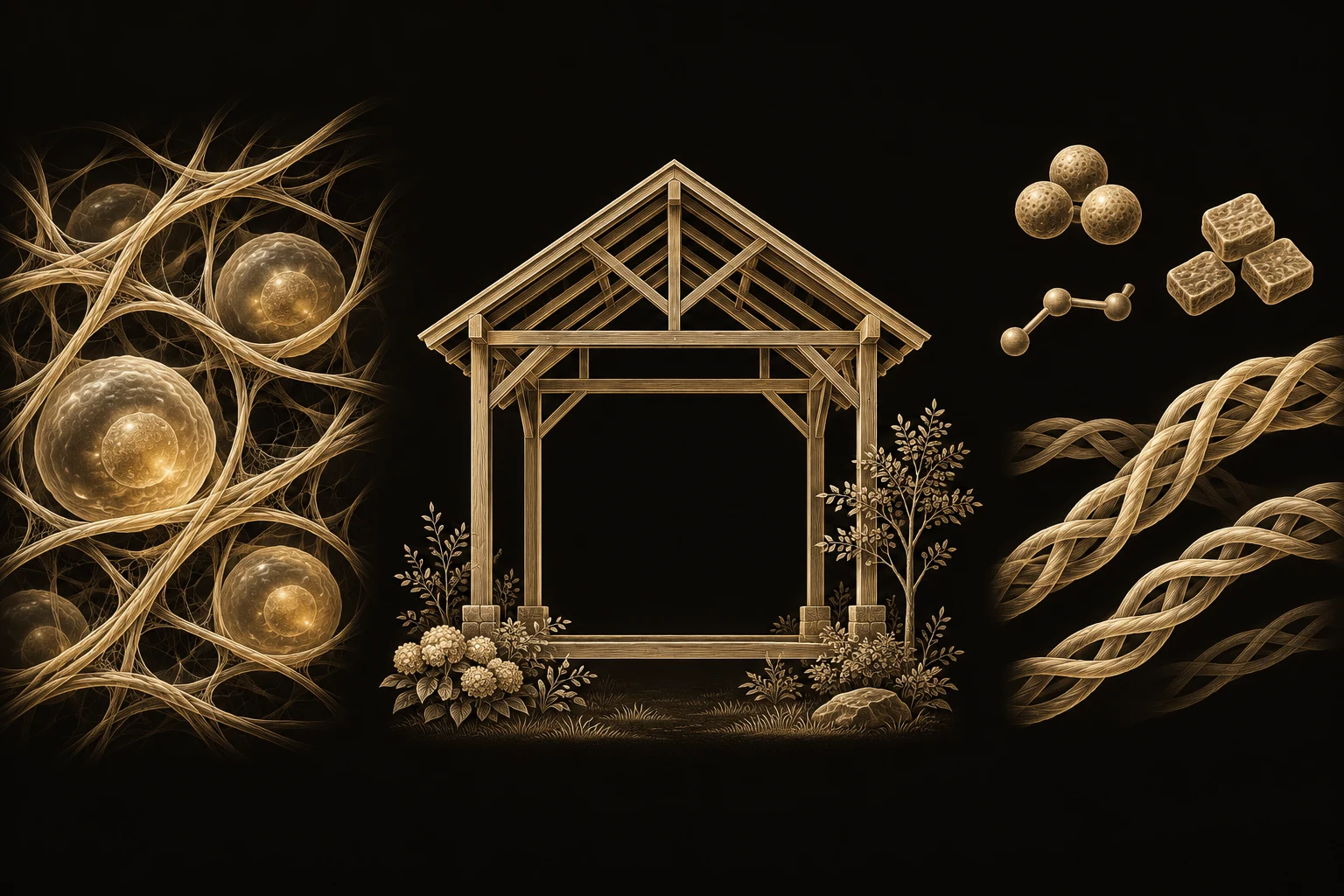
When ECM comes up in conversation, people often ask:
“Is ECM just collagen?”
“What is dECM? Is it something more advanced?”
“How do collagen, ECM and dECM relate to each other?”
No need to worry. Let’s put the papers aside for a moment and explain these three concepts in everyday language.
ECM, dECM and collagen: what are they?
First, remember the names:
ECM = extracellular matrix, the place where cells live.
dECM = decellularized extracellular matrix, the framework of the home.
Collagen = an important component of ECM, like a house’s steel and concrete.
These are not the same thing, and none entirely replaces the others. Each has its own role.
ECM: extracellular matrix
The natural environment around cells
dECM: decellularized extracellular matrix
The “framework” left after cells are removed
Collagen: an important component of ECM
Like a house’s “building materials”
Remember: they are not the same thing. They operate at different levels and have different roles.
A house makes it easier to understand
Let’s use a familiar analogy.
Cells = residents
Cells are like people living in a house. They need somewhere to live, room to move around and opportunities to interact.
ECM = the house
ECM is like a complete living environment. It gives the “residents” somewhere to stay, move around and “communicate” with others.
Collagen = the steel and concrete in the house
Steel and concrete are important: without them, the house would not be stable. But a house cannot consist of those alone. Utilities (glycoproteins), spatial organization (the three-dimensional ECM structure) and other materials (other natural substances) all work together.
So collagen is one of ECM’s important “building materials,” rather than the whole ECM.
Cells = residents
Living, moving, communicating and working inside
ECM = the house + its surroundings
It provides support and also influences cell behavior
Collagen = the house’s building materials
Important, but not the whole house
dECM = the original house after the residents move out
Cells are removed while retaining as much of the original framework as possible
Remember: collagen is only part of ECM, and dECM comes from ECM.
Why isn’t dECM “more advanced collagen”?
dECM = the original house left after its residents move out.
Decellularization is like moving out the “residents” and their belongings, leaving an empty house and garden waiting for the next “resident.”
This is why dECM cannot simply be understood as a “collagen material.”
Its emphasis is on whether the original tissue’s natural structure and matrix environment can be retained.
With that analogy, the relationship becomes clearer:
Collagen: an important building material in the house.
ECM: the complete environment in which cells live.
dECM: the empty house remaining after cells are removed.
ECM is not a more advanced name for collagen. Collagen is an important part of ECM.
Original tissue
Cells + ECM
Decellularization
Removing the “residents” as thoroughly as possible
Obtaining dECM
Leaving a relatively intact matrix framework
What is removed:
Cells and residual material
What is retained:
Structure and the natural environment
The focus is more than:
Whether collagen is present
So dECM places greater emphasis on whether the natural structure and matrix environment are retained.
With ECM / dECM, look beyond collagen
Why should we look beyond collagen when considering ECM/dECM raw materials?
ECM/dECM is about more than whether collagen is present. Other important questions include:
① How many “personal belongings” (residual DNA) remain?
② Has the house’s framework (three-dimensional structure) been damaged?
③ Are the houses in the neighborhood alike? In other words, are different batches consistent?
To sum up:
Collagen is important, but it is only part of ECM.
ECM is the complex natural matrix environment around cells.
dECM is a natural matrix material obtained by removing cells while retaining ECM structure and components as far as possible.
In one sentence:
Collagen is the “building material,” ECM is the “complete environment,” and dECM is the “empty original house left after the residents move out.”
Next time you see ECM, dECM and collagen, remember the house analogy and the terms will be easier to understand.
How much DNA remains?
Has it been removed as thoroughly as possible?
Is the 3D structure intact?
Has the original framework been damaged?
Are batches consistent?
Are different batches more uniform?
In one sentence
Collagen = building materials
ECM = the complete environment
dECM = the original house after the residents move out
Next time you see these terms, they will be easier to tell apart.