Company and product education
Understanding hADM in aesthetic medicine
What is hADM?
hADM means human acellular dermal matrix: processed human dermal tissue from which cells are removed while extracellular matrix components are retained. It is a tissue matrix, not a living-cell product.
01/ 19
Understanding hADM in aesthetic medicine
A clinical perspective, from biological principles to clinical practice. This presentation follows the material’s rationale, development, clinical observations and supporting references.

02/ 19
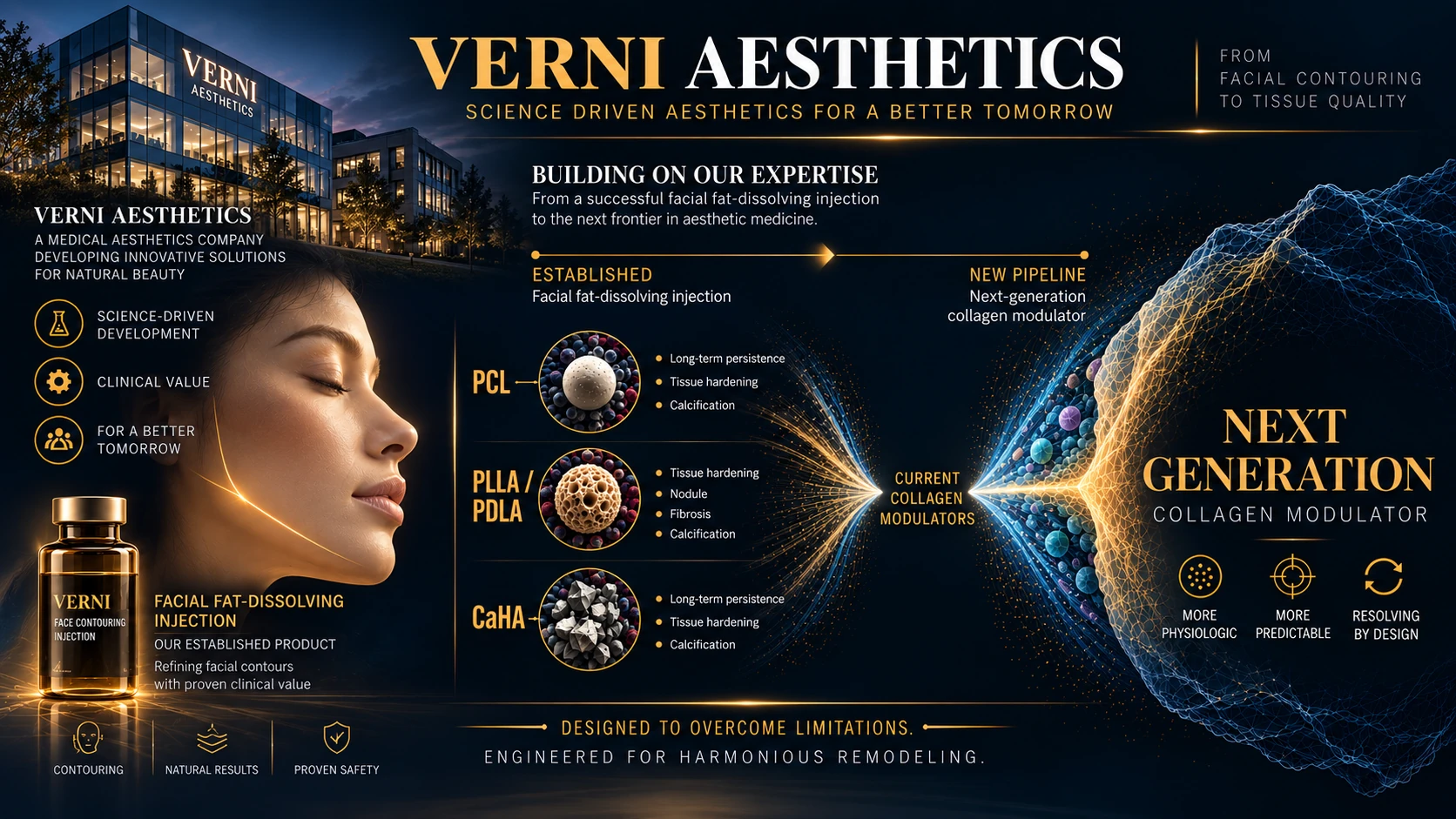
Development background: VERNI AESTHETICS
An introduction to VERNI AESTHETICS, its research background and the design direction of its next-generation collagen modulator.
03/ 19
hADM: human-derived ECM
The source presents hADM as a human-derived extracellular matrix. Its conceptual framework emphasizes physiological compatibility, remodeling and eventual resolution.

04/ 19
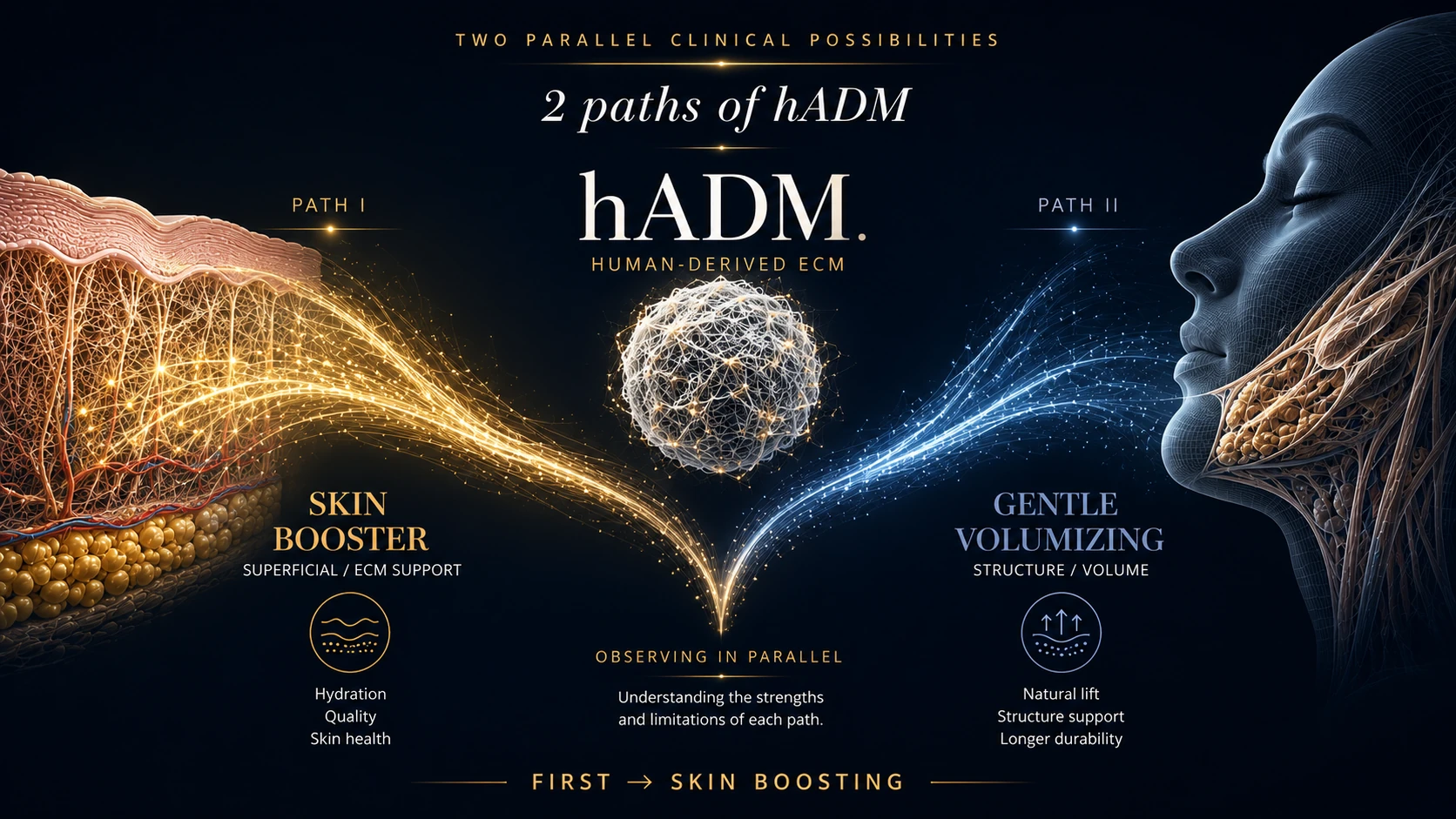
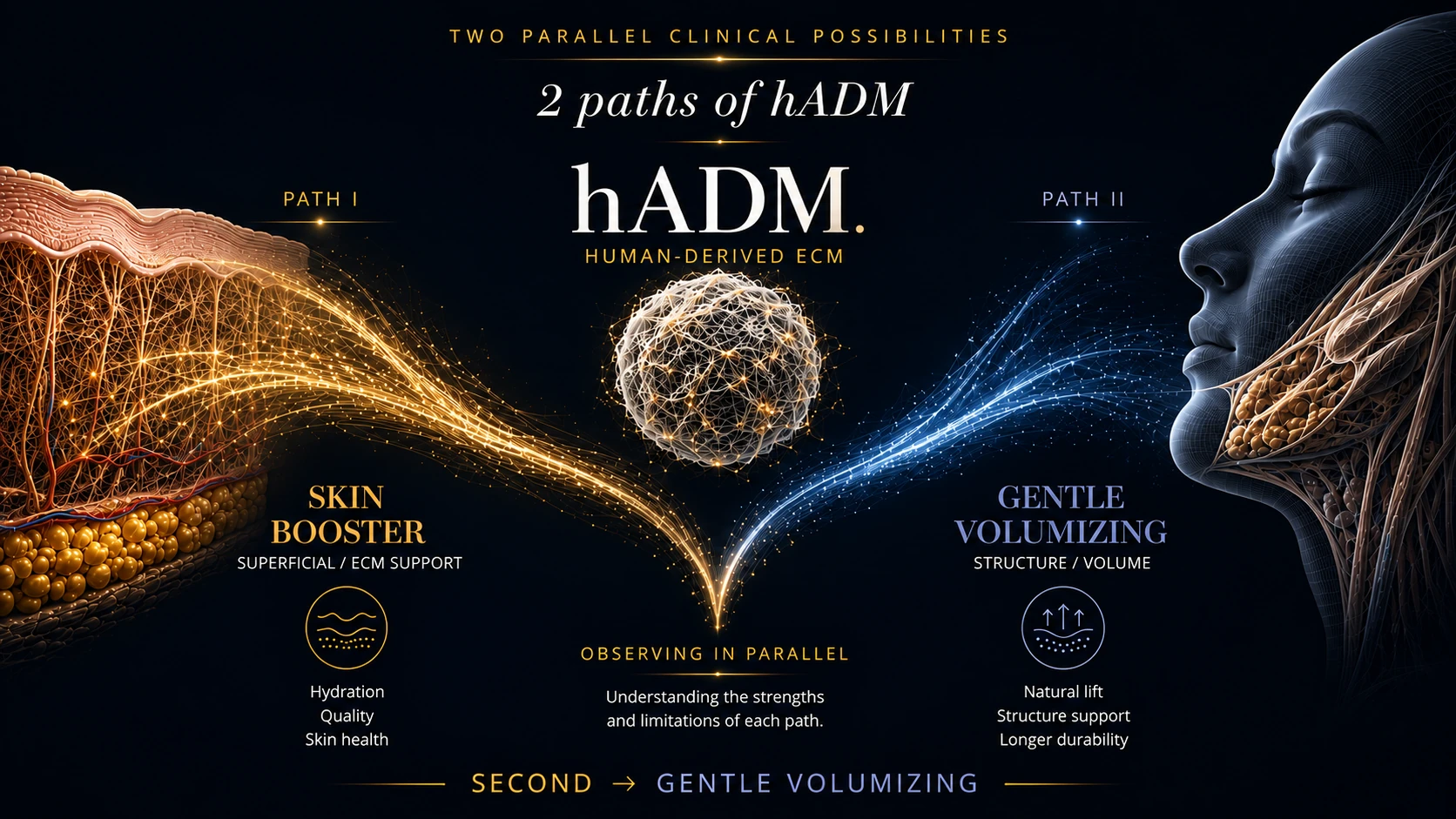
Two paths: skin boosting and gentle volumizing
The presentation distinguishes superficial ECM support for skin quality from structural support for gentle volume. This first part focuses on skin boosting.
05/ 19
Intradermal observations and downtime
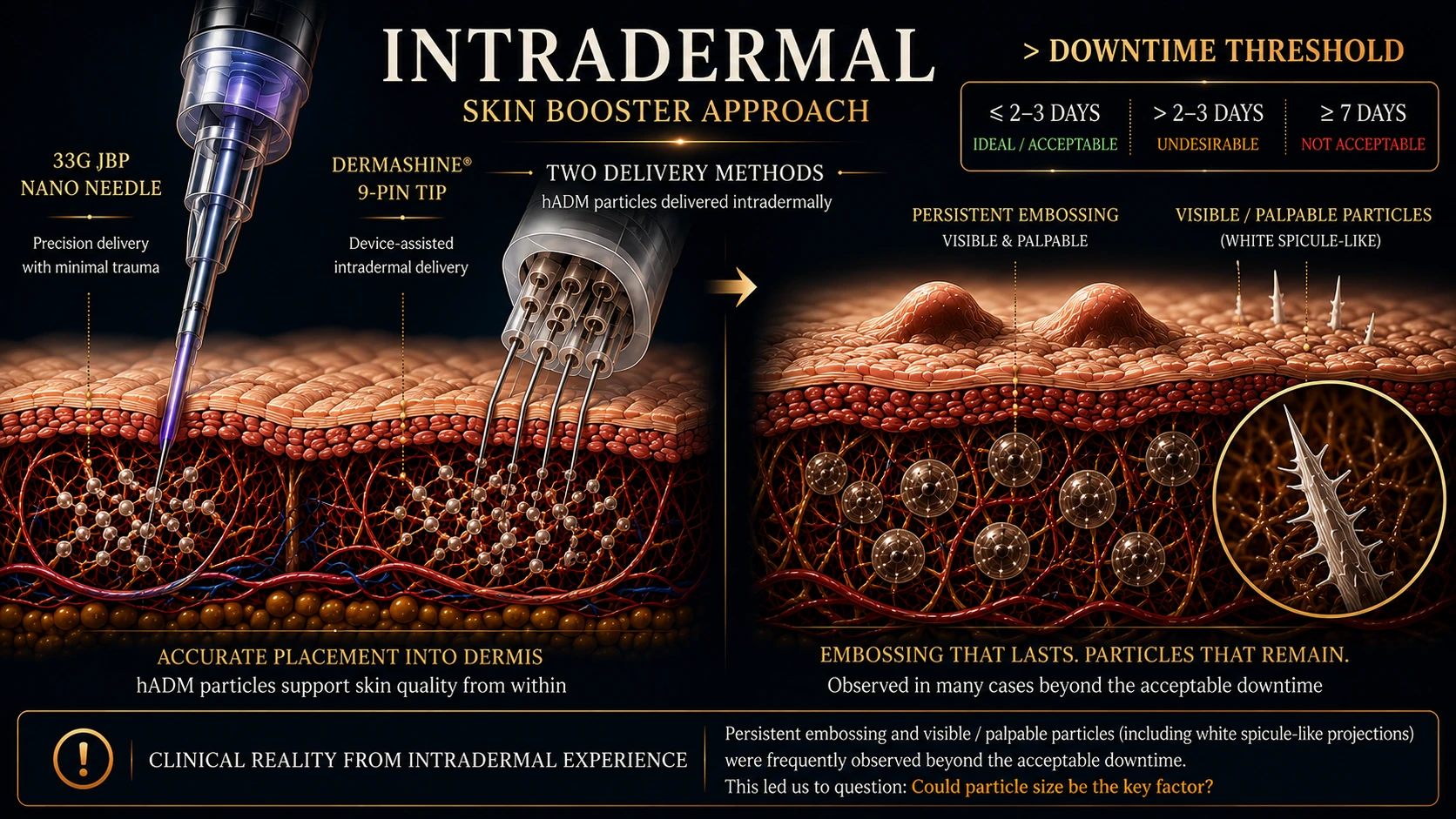
This section records needle- and device-assisted intradermal delivery and clinical observations of persistent embossing and visible or palpable particles. The recovery thresholds are the presenter’s personal acceptance criteria and the starting point for the particle-size research.
Figure details in English
- Delivery methods shown: 33G JBP nano needle and Dermashine 9-pin tip.
- Presenter’s downtime criteria: ≤2–3 days ideal/acceptable; more than 2–3 days undesirable; ≥7 days unacceptable.
- Observations: persistent embossing and visible or palpable particles, including white spicule-like projections. The source asks whether particle size could be a factor.
06/ 19
Particle size: a preclinical pilot study
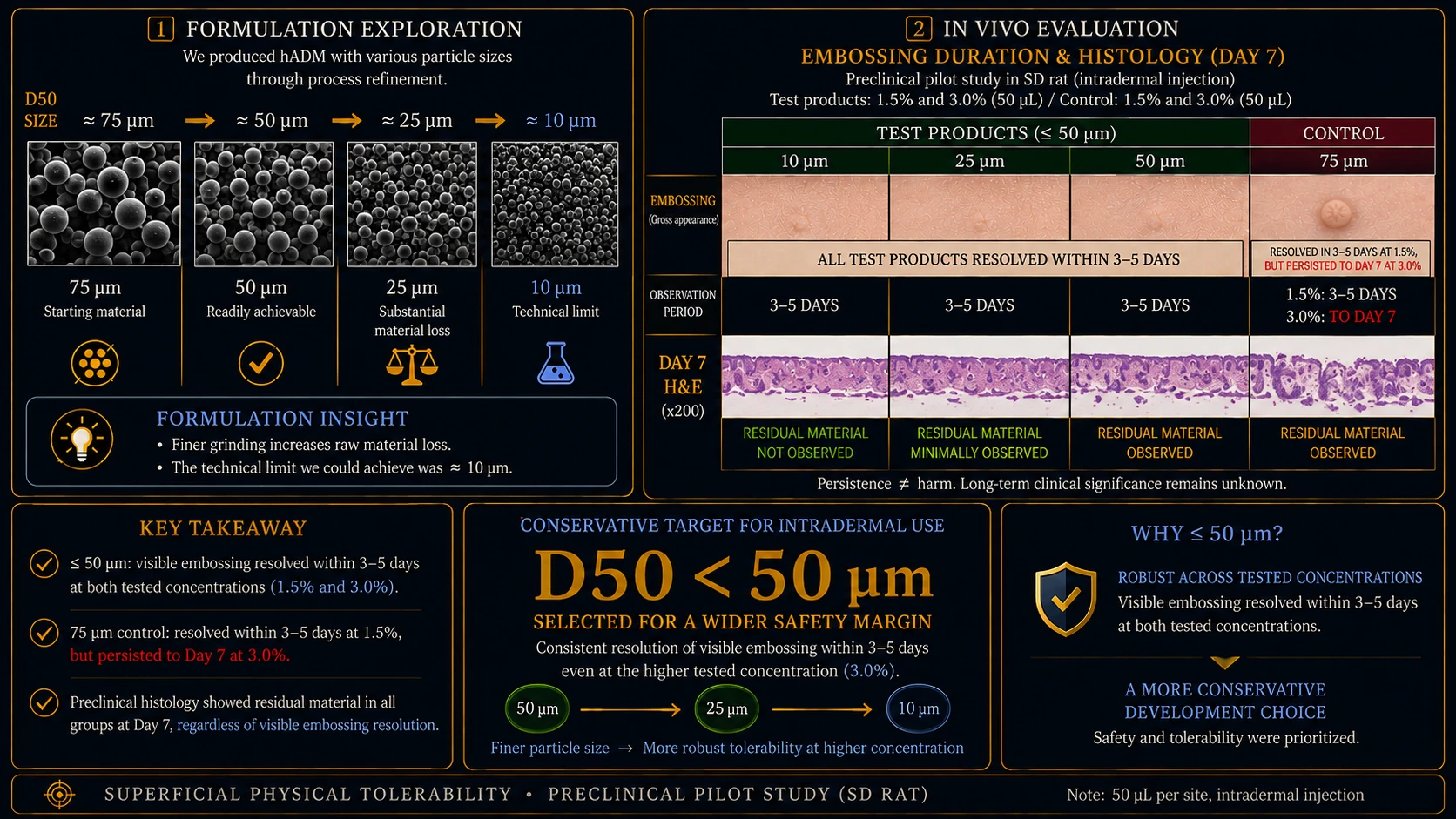
An SD-rat pilot study compares appearance and day-7 histology across particle sizes and concentrations. It proposes D50 < 50 μm as a development target. This short-term animal study provides no long-term human clinical conclusion; surface recovery and material degradation are separate outcomes.
Figure details in English
- Formulation exploration: approximately 75, 50, 25 and 10 μm. Finer grinding increased material loss; approximately 10 μm was the stated technical limit.
- SD-rat intradermal pilot: 1.5% and 3.0% concentrations, 50 μL per site. Visible embossing resolved within 3–5 days for the ≤50 μm test groups; the 75 μm control at 3.0% persisted to day 7.
- Development target: D50 <50 μm. Persistence does not itself establish harm, and long-term clinical significance remains unknown.
- The source has an internal inconsistency: the histology table says residual material was not observed at 10 μm, while the takeaway says it was found in all groups. Both remain visible in the original; no single conclusion is substituted.
07/ 19
The development journey
The development timeline covers formulation, particle-size research, pilot testing, patent filing and tissue-bank discussions. The presenter attributes the pause to business decisions concerning infrastructure and global expansion.

08/ 19
Product figures shown in the presentation
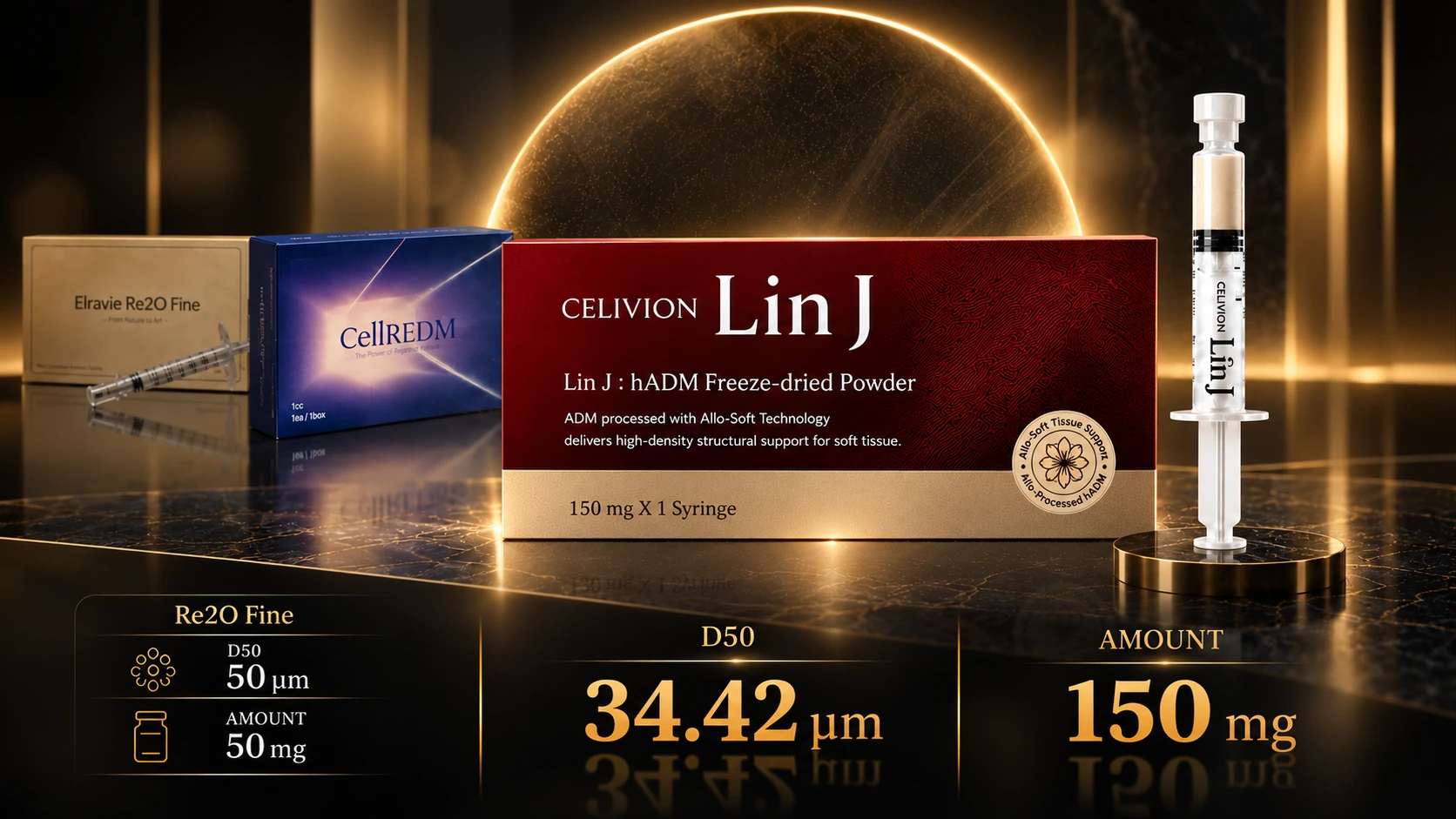
Product figures in the presentation: CELIVION Lin J, D50 34.42 μm and 150 mg; Re2O Fine, D50 50 μm and 50 mg. The attached presentation is the source of these figures.
Figure details in English
- CELIVION Lin J: freeze-dried hADM powder; D50 34.42 μm; 150 mg.
- Re2O Fine: D50 50 μm; 50 mg. These values belong to this presentation and are not harmonized with other source documents.
09/ 19
Clinical experience with CELIVION
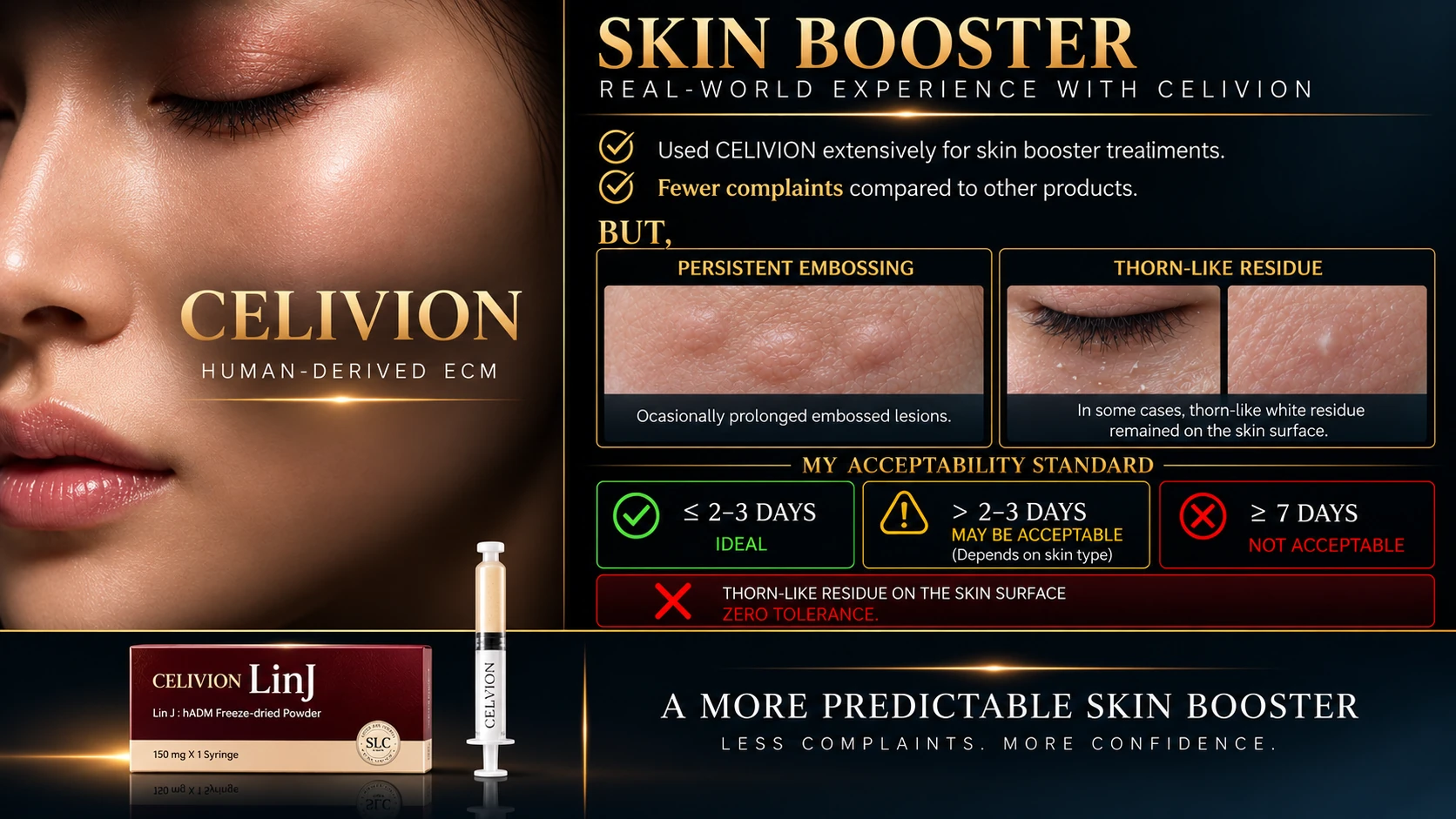
The presenter’s personal clinical records describe fewer complaints, occasional persistent embossing and thorn-like surface residue. This section sets out the presenter’s recovery criteria and goal of more predictable results.
Figure details in English
- Reported observations: fewer complaints compared with other products in the presenter’s experience, but occasional prolonged embossing and thorn-like white residue.
- Personal criteria: ≤2–3 days ideal; longer recovery may be acceptable depending on skin type; ≥7 days unacceptable. Surface thorn-like residue was considered unacceptable.
10/ 19
Injection plane and tissue support
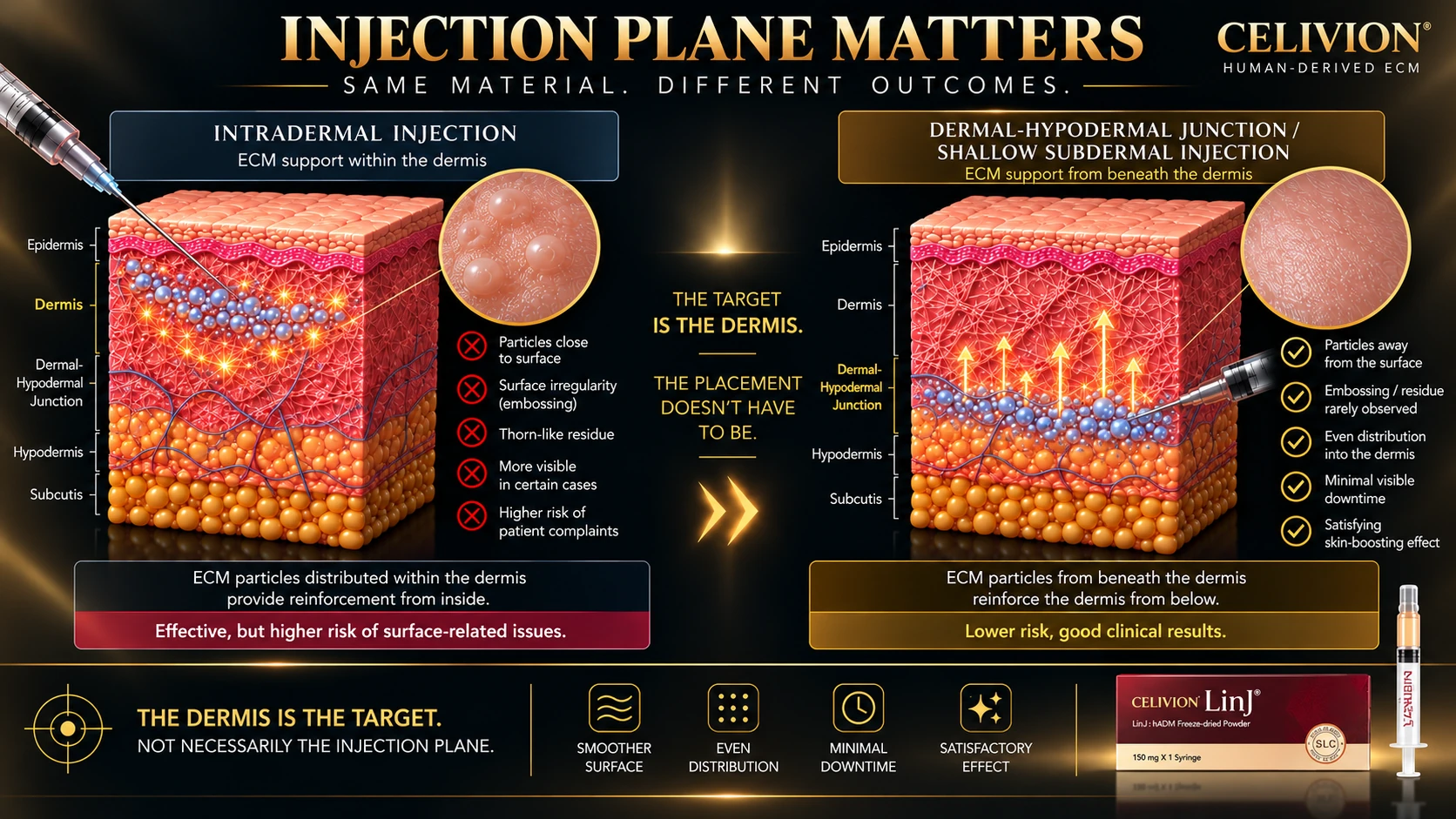
Diagrams based on the presenter’s clinical observations illustrate intradermal and subdermal support, particle position, surface irregularities and distribution. They explain observations; treatment decisions follow formal product instructions and clinical assessment.
Figure details in English
- Within the dermis: the source describes internal ECM support, with particles closer to the surface and potential visible irregularities.
- Dermal–hypodermal junction or shallow subdermal plane: the presenter describes support from beneath the dermis and fewer surface-related findings in their experience.
- Key distinction in the source: the target tissue and the placement plane are not necessarily identical.
11/ 19
The second path: gentle volumizing
The presentation returns to the two-path framework and shifts its focus to structural support, subtle volume and integration with surrounding tissue.
12/ 19
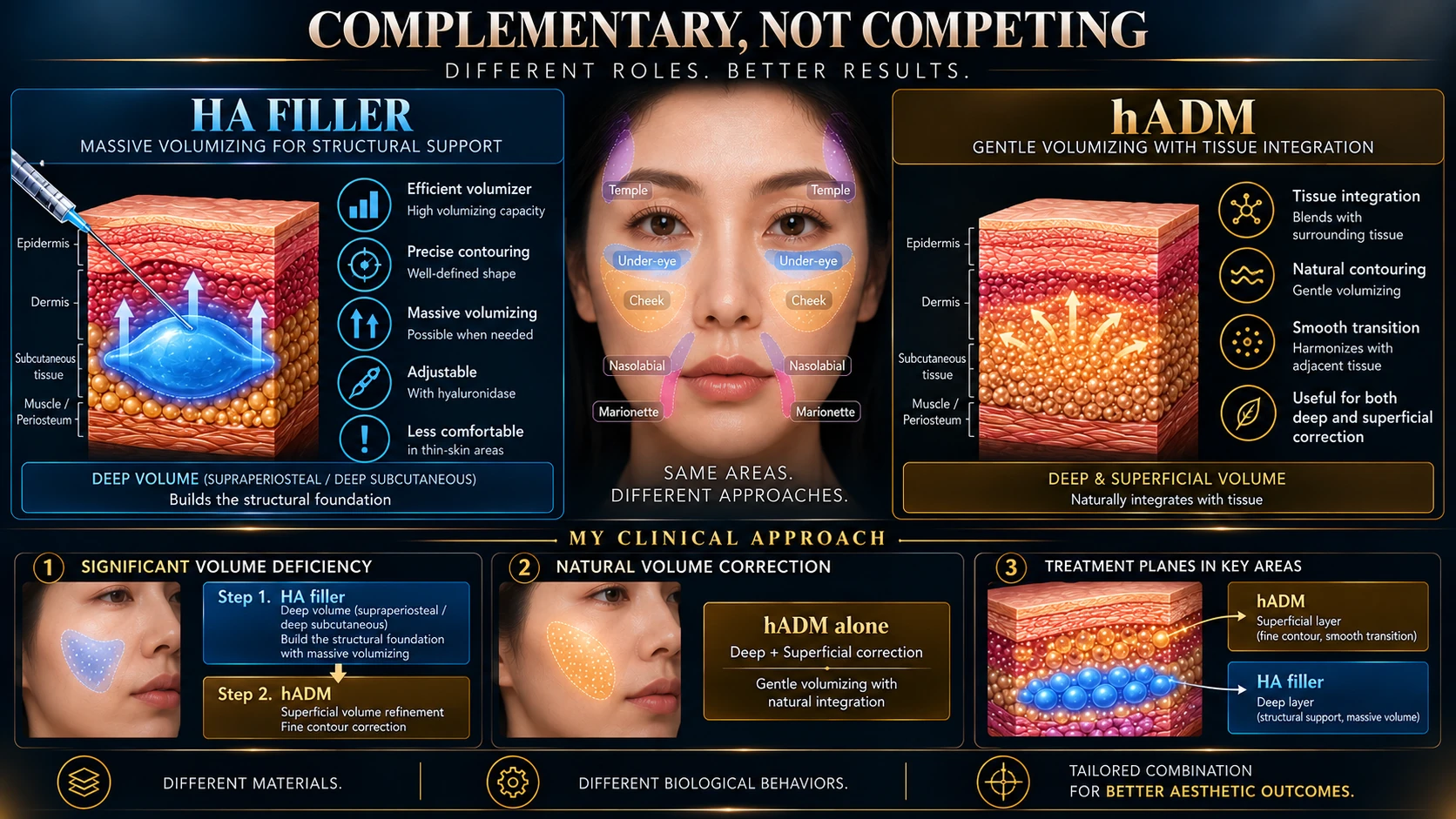
HA filler and hADM: complementary roles
The presenter distinguishes the structural volume and contouring role of HA filler from the tissue-integration and gentle-volume concept of hADM. The source illustrates individual and combined approaches according to the intended correction.
Figure details in English
- HA filler: structural support, stronger volume and precise contouring; the source discusses deep placement and adjustment with hyaluronidase.
- hADM: tissue integration, gentle volume and smooth transitions; the source discusses both deeper and superficial correction.
- The presenter describes combined treatment for significant volume deficiency and hADM alone for selected natural-volume correction. These are personal clinical approaches.
13/ 19
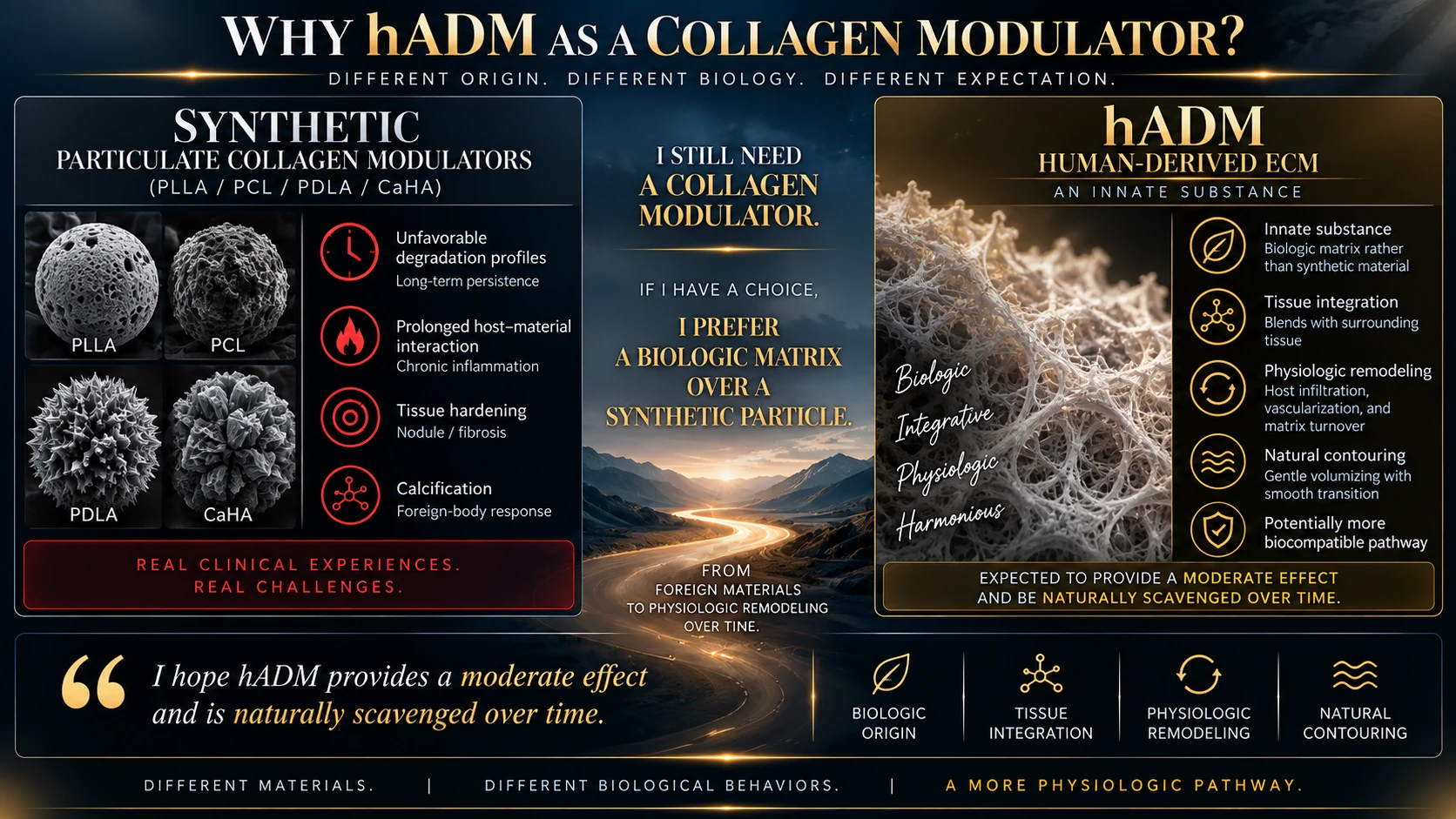
Why consider a biological matrix?
This section explains the presenter’s material-selection rationale through synthetic particles, human-derived matrix, tissue integration and physiological remodeling. It presents a material-design concept.
Figure details in English
- Synthetic materials discussed: PLLA, PCL, PDLA and CaHA. The source raises persistence, host interaction, hardening, nodules, fibrosis and calcification as concerns from clinical experience.
- Biological-matrix rationale: tissue integration, host infiltration, vascularization and matrix turnover.
- The presenter expresses a preference and a hope for moderate effects with natural clearance over time; these statements are expectations, not proven comparative outcomes.
14/ 19
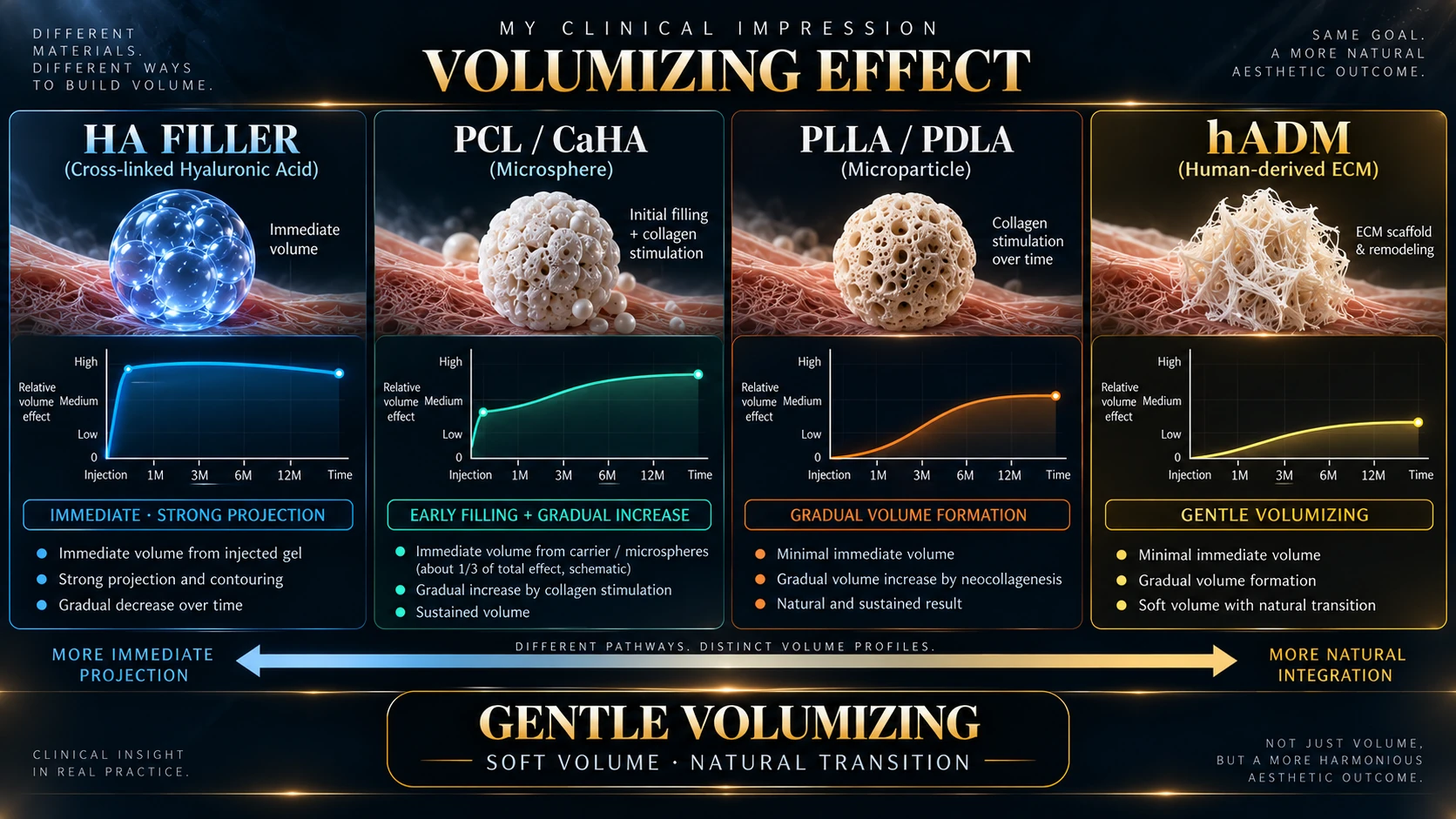
Volume profiles: a clinical impression
Schematic volume profiles for HA, PCL/CaHA, PLLA/PDLA and hADM express the presenter’s clinical impressions. These are conceptual illustrations without quantitative head-to-head trial data.
Figure details in English
- HA filler: immediate volume and projection, followed by a gradual decrease.
- PCL/CaHA: early filling plus a gradual increase associated with collagen stimulation. PLLA/PDLA: gradual volume formation over time.
- hADM: minimal immediate volume, gradual volume formation and soft transitions. All curves are schematic clinical impressions, not measured comparative trajectories.
15/ 19
Natural-looking volume: the patient perspective
This Korean-language slide explores the desire for enough volume without an obviously filled appearance. The original patient-facing wording and illustrations are preserved in the source image.

16/ 19
The presenter’s preparation framework
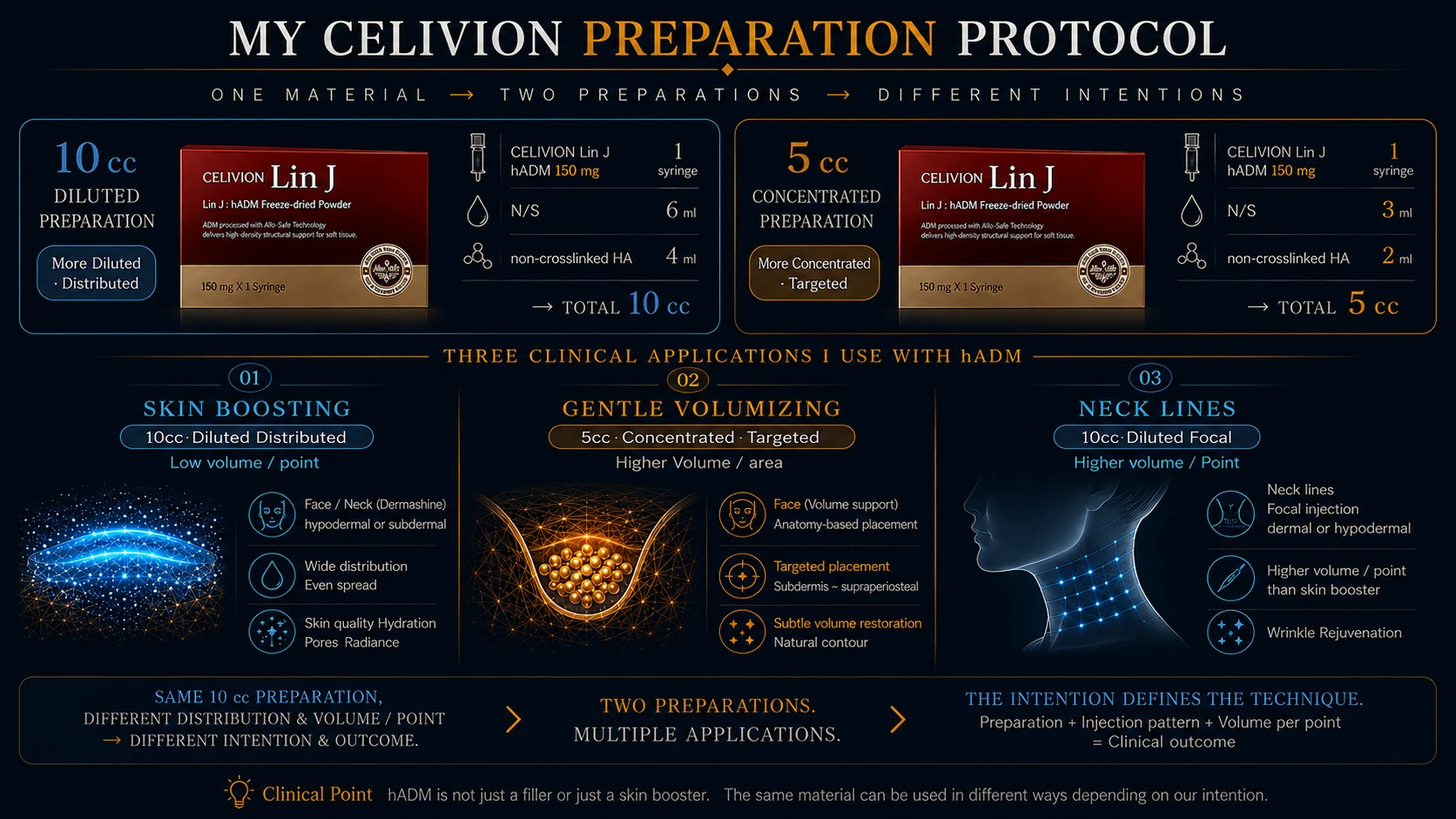
The presenter’s personal protocol documents two preparations and three application areas: skin quality, gentle volumizing and neck lines. The original slide records quantities, combinations and techniques; this is presentation material, not CELIVION instructions for use.
Figure details in English
- Source’s diluted preparation: hADM 150 mg with 6 mL normal saline and 4 mL non-crosslinked HA, totaling 10 cc.
- Source’s concentrated preparation: hADM 150 mg with 3 mL normal saline and 2 mL non-crosslinked HA, totaling 5 cc.
- Three source applications: skin boosting (diluted/distributed), gentle volumizing (concentrated/targeted), and neck lines (diluted/focal). The presenter emphasizes preparation, distribution and volume per point.
- These are the presenter’s reported preparations, not manufacturer instructions or a general treatment recommendation.
17/ 19
The presenter’s post-treatment protocol
The presenter’s personal aftercare protocol covers facial treatment and neck/body lines. The original slide retains the medication and timing records; individual medication decisions belong to the treating clinician.
Figure details in English
- Most facial treatments: the presenter reports an oral antihistamine plus an oral corticosteroid for 3 days.
- Neck/body lines: the same oral combination for 3 days plus a topical corticosteroid for 7 days.
- The photograph is labeled post-treatment dermatitis, day 7 after neck-line treatment. It is retained without color or contrast alteration.
- This page documents the presenter’s aftercare practice, not a general prescribing recommendation.

18/ 19
Four considerations brought together
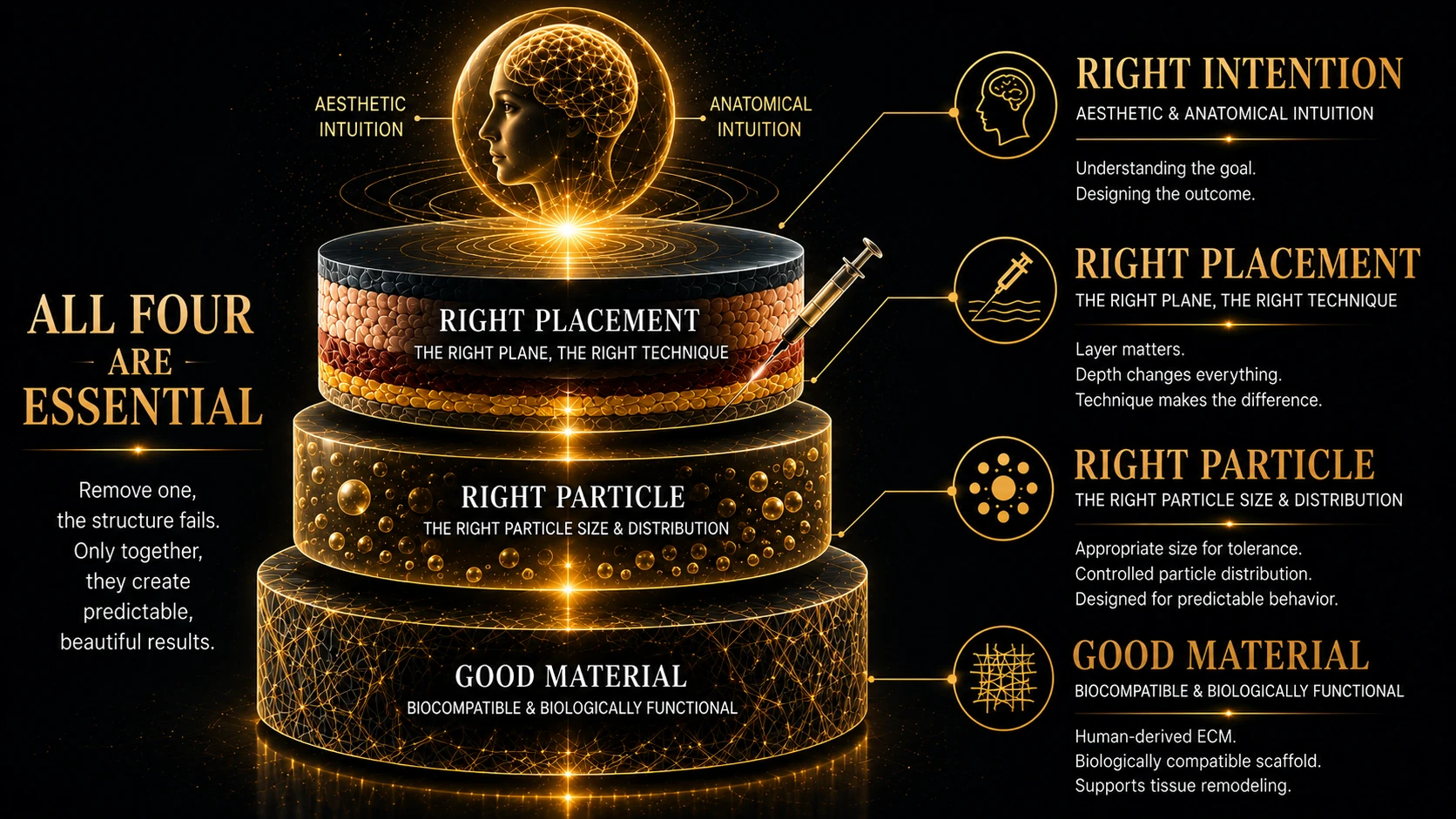
This section brings together four material-application factors: the intended outcome, placement and technique, particle characteristics, and material quality.
Figure details in English
- Right intention: define the aesthetic and anatomical goal.
- Right placement: plane, depth and technique.
- Right particle: particle size and distribution.
- Good material: a biologically compatible, functional matrix. The source presents all four as interconnected.
19/ 19
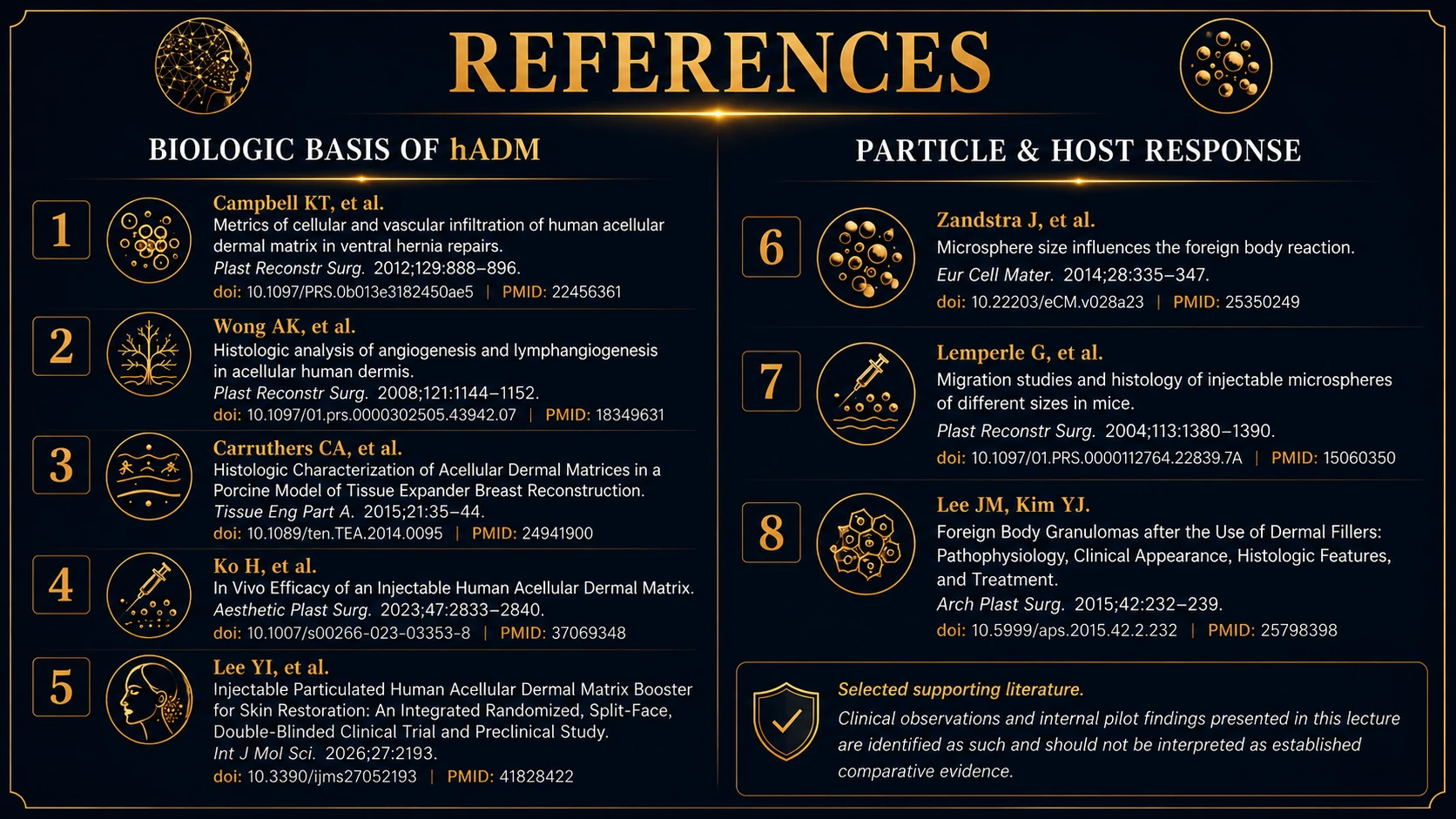
References and scope of evidence
Eight references cover the biological basis of hADM and particle–host responses. Source types include published literature, clinical observations and internal pilot studies; references and study types are identified in the original slide.