Composition analysis
| Collagen | approx. 82.8% 1 |
|---|---|
| Elastin | approx. 4.7% 1 |
| Elastin retention rate (versus native skin) | approx. 85.6% 1 |
| GAGs (glycosaminoglycans) | approx. 0.23% 1 |

Home / Professional
Company and product education
This section presents product specifications, composition and material information for company and product education and preliminary promotion.
What is an hADM / acellular dermal matrix skin booster?
| Product name | Celivion Lin J (also written Celivion LinJ in some catalogue lines) |
|---|---|
| Material | Micronized human acellular dermal matrix (hADM) |
| Brand materials description | ECM Skin Reviser |
| Presentation | 150 mg freeze-dried powder |
| Process names | Allo-PELT™ (Preserved ECM at Low Temperature Processed); ECM Mix Cage™ |
| Particle profile | Mean 33.92 μm; D10 3.23 μm; D50 34.42 μm; D90 61.82 μm |
| Storage (catalogue) | 1–30°C |
| Residual DNA (listed analysis) | 40 ng/mg |
| Cytotoxicity viability (listed analysis) | 94.8% |
Specifications are taken from the CELIVION product brochure and catalogue.
Composition-analysis values: collagen ≈82.8%, elastin ≈4.7%, glycosaminoglycans (GAGs) ≈0.23%. Elastin relative to native skin is about 85.6%.
CELIVION LinJ
For Healthcare Professionals Only
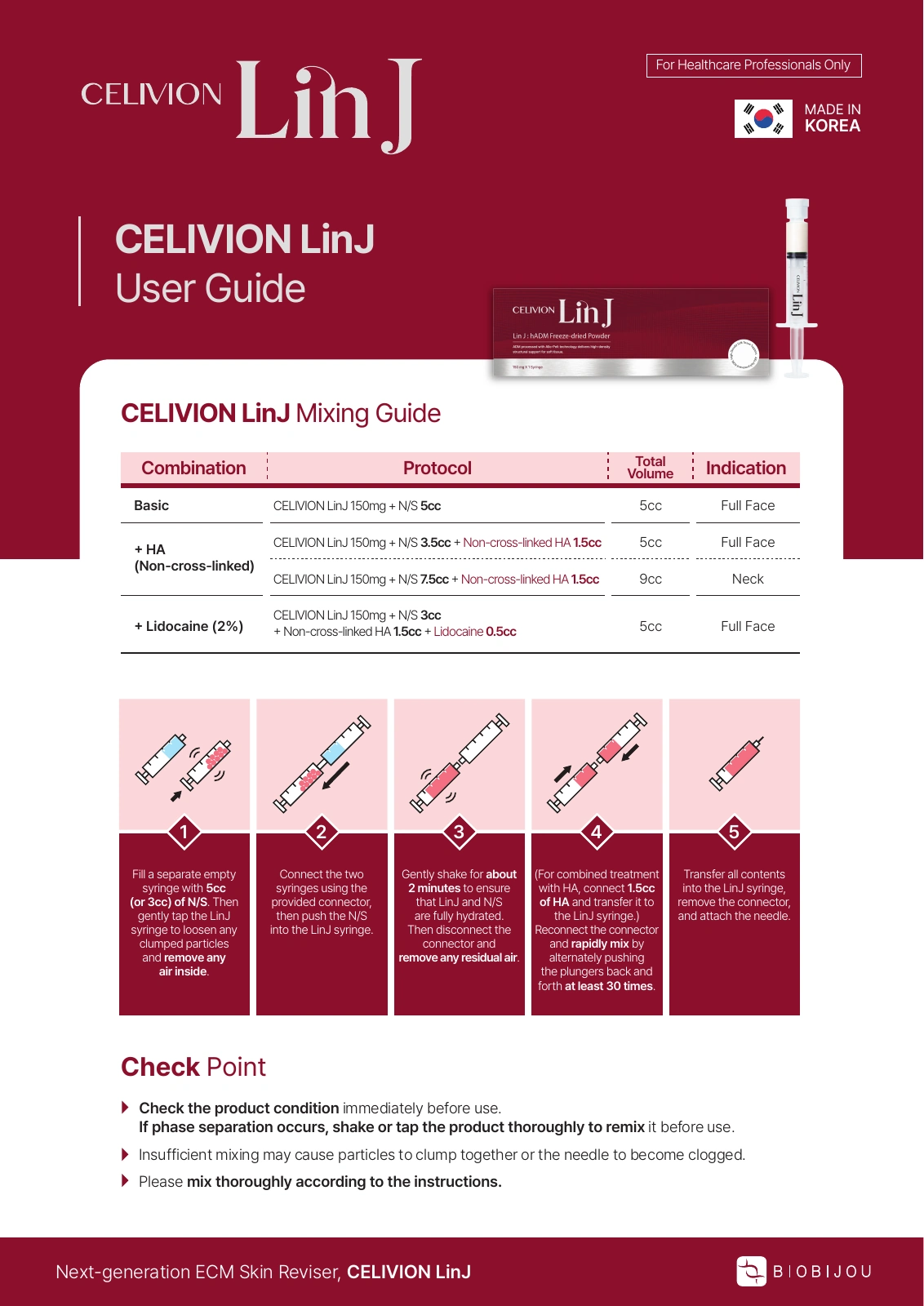
| Combination | Protocol | Total volume | Indication |
|---|---|---|---|
| Basic | CELIVION LinJ 150mg + N/S 5cc | 5cc | Full Face |
| + HA (non-cross-linked) | CELIVION LinJ 150mg + N/S 3.5cc + non-cross-linked HA 1.5cc | 5cc | Full Face |
| + HA (non-cross-linked) | CELIVION LinJ 150mg + N/S 7.5cc + non-cross-linked HA 1.5cc | 9cc | Neck |
| + Lidocaine (2%) | CELIVION LinJ 150mg + N/S 3cc + non-cross-linked HA 1.5cc + Lidocaine 0.5cc | 5cc | Full Face |
↔ Swipe horizontally to view the complete table
Fill a separate empty syringe with 5cc (or 3cc) of N/S. Then gently tap the LinJ syringe to loosen any clumped particles and remove any air inside.
Connect the two syringes using the provided connector, then push the N/S into the LinJ syringe.
Gently shake for about 2 minutes to ensure that LinJ and N/S are fully hydrated. Then disconnect the connector and remove any residual air.
(For combined treatment with HA, connect 1.5cc of HA and transfer it to the LinJ syringe.) Reconnect the connector and rapidly mix by alternately pushing the plungers back and forth at least 30 times.
Transfer all contents into the LinJ syringe, remove the connector, and attach the needle.
For Healthcare Professionals Only
| Treatment area | Injection method | Target layer | Details |
|---|---|---|---|
Face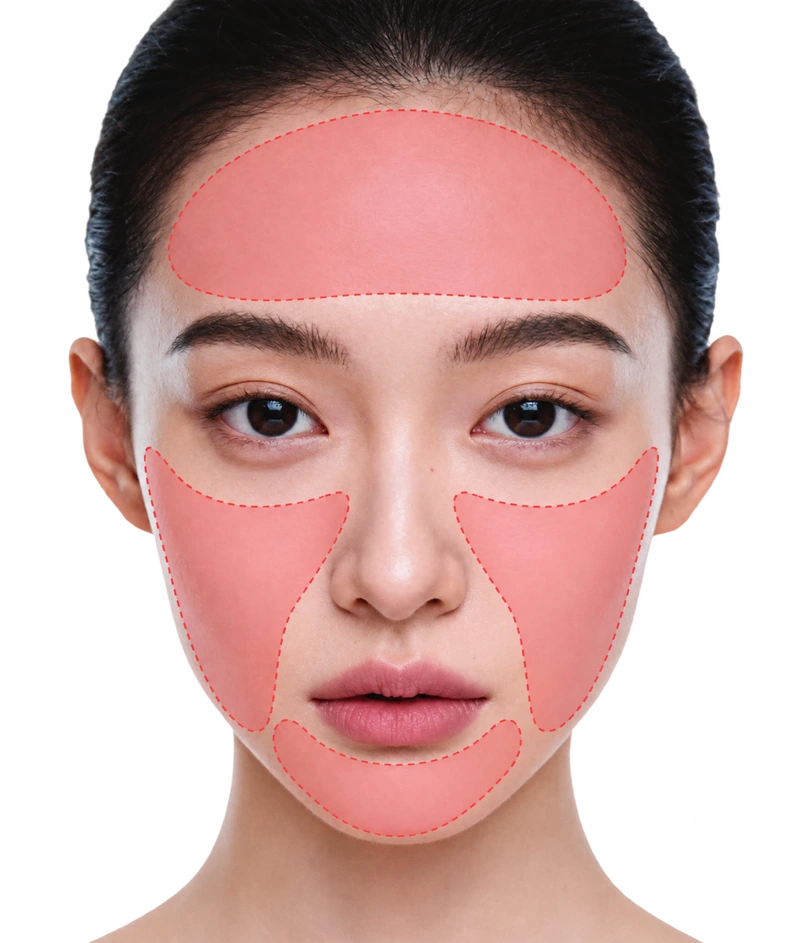 | Needle 32~34G / 4mm | Deep Dermis (45~60°) | 0.02~0.05ml/point |
| Cannula 23/25G / 5cm | Deep Dermis (45~60°) | 0.1ml/stroke | |
Under-eye / Nasolabial / Marionette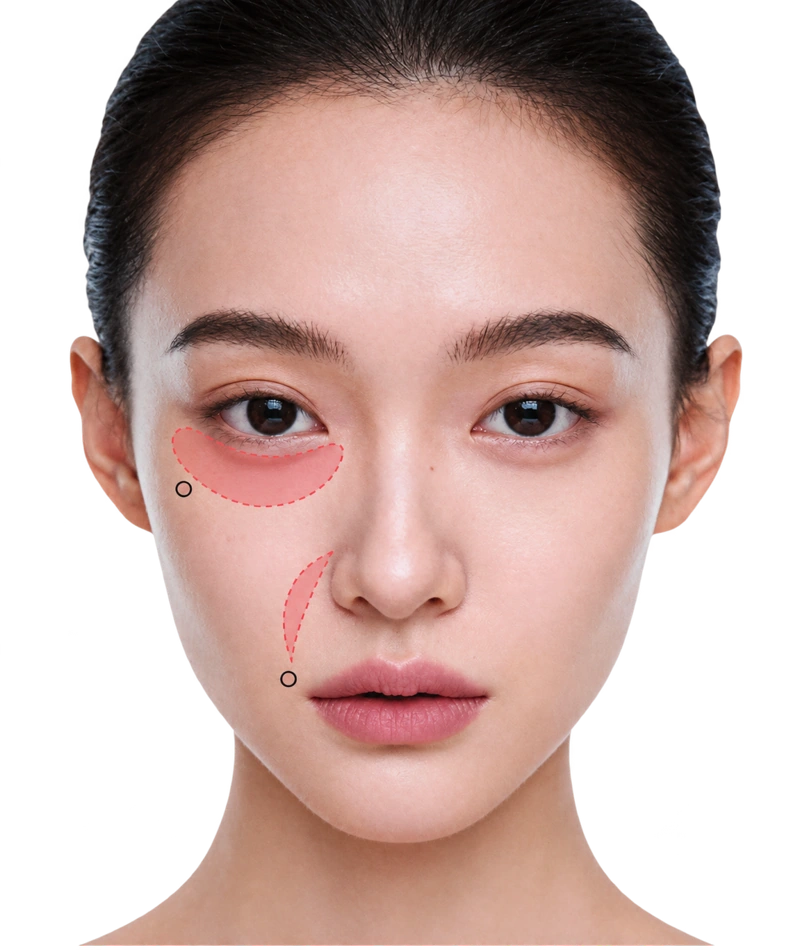 | Cannula 23/25G / 5cm | Immediate Subdermis / Supraperiosteum ~ Subdermis | Under-eye: 0.5~0.8ml/side Nasolabial: 1~1.5ml/side |
Neck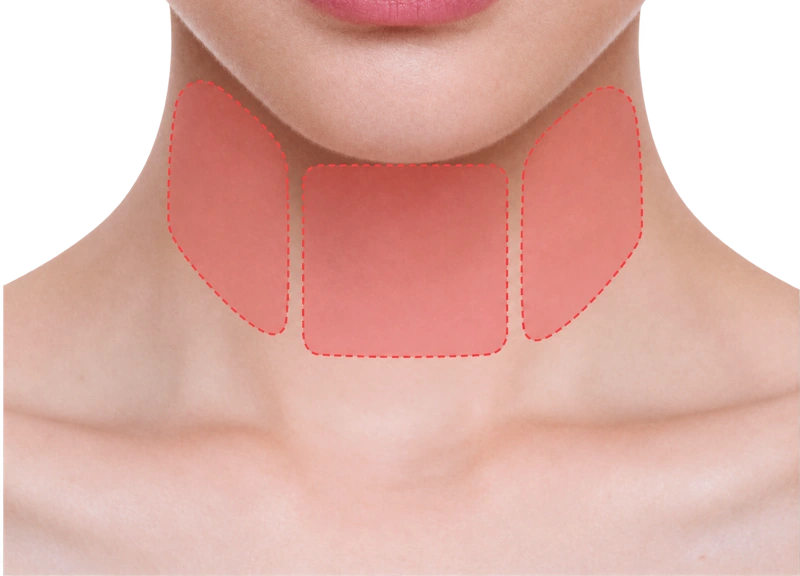 | Needle 32~34G / 4mm | Deep Dermis ~ Subcutaneous | 0.025ml/point Left: 2ml / Center: 1ml / Right: 2ml |
| Cannula 25~26G / 5cm | Immediate Subdermis | 5ml/side |
↔ Swipe horizontally to view the complete table
Safety & Quality
They describe the tests and documents as presented in those materials.
| Collagen | approx. 82.8% 1 |
|---|---|
| Elastin | approx. 4.7% 1 |
| Elastin retention rate (versus native skin) | approx. 85.6% 1 |
| GAGs (glycosaminoglycans) | approx. 0.23% 1 |
Residual DNA is listed as 40 ng/mg by ELISA, against a 50 ng/mg safety threshold cited in the same documentation. 2
Surfactant residue (Triton X-100) is listed as 0.004% (40 mg/kg) by HPLC-ELSD. 3
The listed average P2/P3 ratio for Celivion is 0.990 (standard deviation 0.023). The listing states that the closer the ratio is to 1, the less denaturation has occurred, and that a value of approximately 1.0 is described as intact collagen. This page reports the listed ratio. 4
Mean 33.92 μm; D10 3.23 μm; D50 34.42 μm; D90 61.82 μm. The charts are labelled Skin-Test (80 μm or less), sample ID #26006. 5
See the Core technology section for the particle-profile table.
An extraction test is listed with the method cited as ISO 10993-12, performed by KTR. Under the listed conditions — extraction 24 hours, 37°C, 120 rpm, L929 cells, incubation 48 hours — the Celivion value is 94.8% (MEM medium 100.0%, negative control 106.2%, positive control 11.4%). These are listed cell-viability figures for that test. The test-sample label visible in the source materials also records electron-beam sterilization at 15–30 kGy. 6
Screening covers ten serological tests, including HBV-NAT in addition to the nine tests referenced under Article 13 of Korea’s Human Tissue Act. The ten listed tests are: 7
An establishment licence was issued to BIOBIJOU Co., Ltd. ((주)바이오비쥬). Permit No. 336, from the Gyeongin Regional Office of the Ministry of Food and Drug Safety (MFDS) of the Republic of Korea, is valid from 26 February 2026 to 25 February 2029. The licence type is tissue importer. Permitted activities are storage, distribution and import of bone, cartilage, fascia and skin. 8
This is a facility licence.
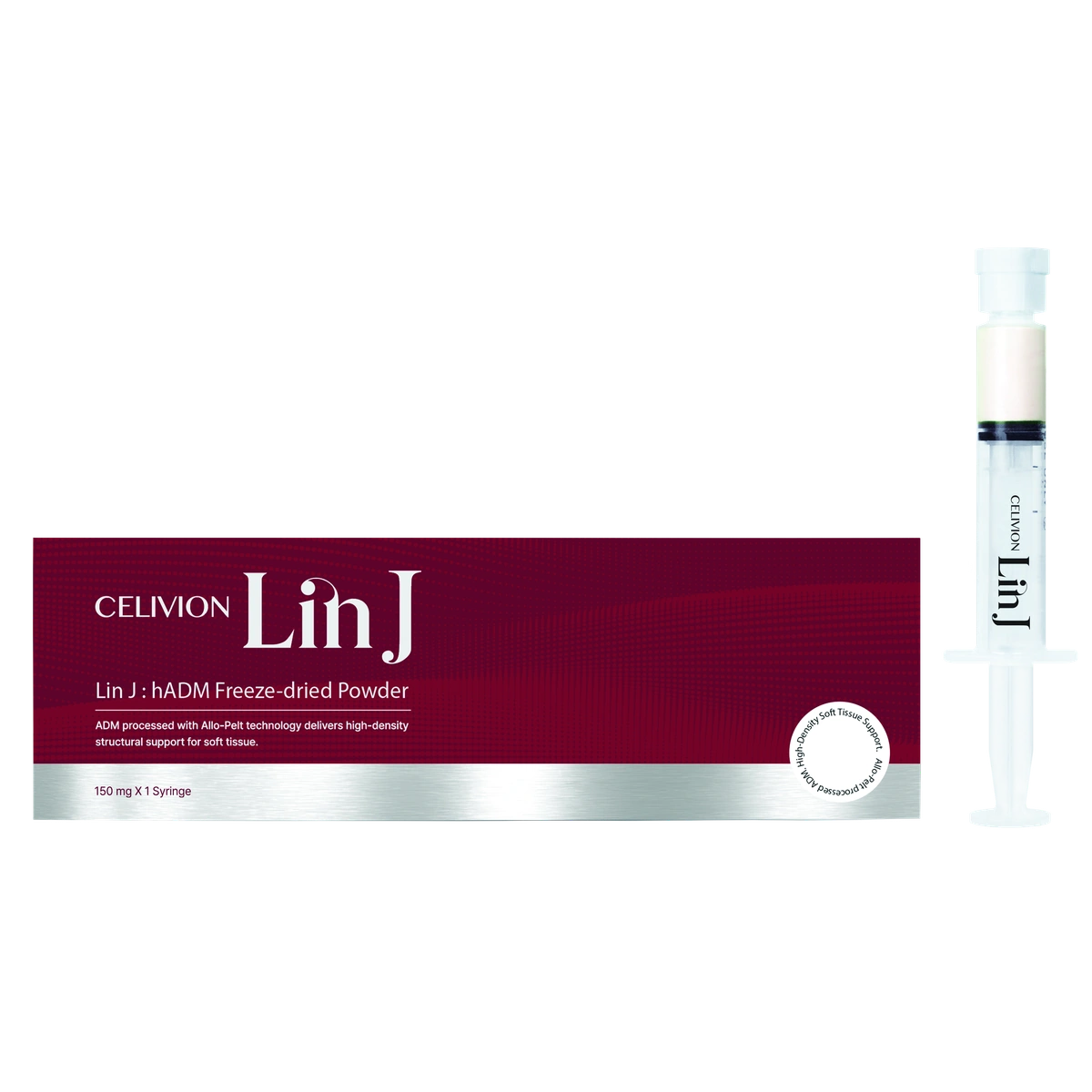
Celivion Lin J is introduced as a micronized human acellular dermal matrix (hADM), presented as 150 mg freeze-dried powder. The brand materials description is ECM Skin Reviser.
Composition analysis lists about 82.8% collagen, 4.7% elastin and 0.23% GAGs.
They are listed as 3.23 μm, 34.42 μm and 61.82 μm, with a mean particle size of 33.92 μm.
Email [email protected].
Allo-PELT™ (“Preserved ECM at Low Temperature Processed”) is the name of the low-temperature decellularization process used for Celivion Lin J. It is a stepwise low-temperature circulation system intended to retain ECM components, and it does not use acetic acid or pepsin. Process details and patent content are not disclosed.
ECM Mix Cage™ is the name of the particle step: milling, sizing and ratio management that turn the decellularized matrix into fine particles. It follows Allo-PELT™ decellularization. Technical details are not disclosed.
Triton X-100 residue was measured at 0.004% (40 mg/kg) by HPLC-ELSD, Koptri test report No. 25-01200, as reproduced in the product brochure.
The listing shows 94.8% cell viability for the product extract (MEM medium 100.0%, negative control 106.2%, positive control 11.4%). The test by KTR used a 24-hour extraction at 37 °C, L929 cells and a 48-hour incubation, with sample preparation per ISO 10993-12 as given in the product brochure.
Residual DNA is 40 ng/mg (ELISA).
Licence No. 336 is a Korean tissue-bank establishment licence. It covers a tissue importer (storage, distribution and import, without processing) and is valid from February 26, 2026 to February 25, 2029.
HA fillers are based on hyaluronic acid gel. hADM is a different kind of material: a processed human dermal matrix made mainly of collagen, with elastin and GAGs.
See the user guide in the Product education.
Store at 1–30°C.
For product traceability and verification information, email [email protected].
Company and product information
For company or product information, email [email protected]. This website is solely for education and preliminary promotion and does not accept online orders or payments.
For company or product information, email [email protected]. This website is solely for education and preliminary promotion and does not accept online orders or payments.
For company or product information, email [email protected]. This website is solely for education and preliminary promotion and does not accept online orders or payments.